

Archive for January, 2011
 
MIND HACKS
I love this summary of a study on unusual hallucinations in an elderly Japanese lady.
The full article is in Japanese but the translation of the abstract and the form of her hallucinations gives it a stylised quality that reminds me of the traditional art from the country.
The last sentence is wonderfully zen-like.
[Formed visual hallucination after excision of the right temporo parietal cystic meningioma–a case report.]
Brain Nerve. 2010 Aug;62(8):893-7.
Yoshimura M, Uchiyama Y, Kaneko A, Hayashi N, Yamanaka K, Iwai Y.
We report the case of a 64-year-old woman with cystic meningioma; this patients was otherwise healthy and experienced formed visual hallucinations after excision of the tumor. She experienced diplopia associated with metamorphopsia, which had persisted for 5 years only when she laid down and turned on her left side.Â
Read in Full:Â http://mindhacksblog.wordpress.com/2010/08/18/flowers-on-stones-falling-maple-leaves-and-wriggling-dwarves/
 
iPad Apps That Help Autistic Children’s Development(Video)
First Posted: 08-18-10 10:17 AMÂ Â Â |Â Â Â Updated: 08-18-10 11:39 AMÂ
The mother of Nolan, a young boy diagnosed with autism, found herself pleasantly surprised by what technology could do to help her son’s development.
Nolan’s mom created a list of fun iPad apps that are also useful for learning social skills, fine motor skills, language and communication skills, sensory skills and others.
This video highlights a few of her and Nolan’s favorites, like Tom the Talking Cat, who repeats back out loud whatever you say — just the way you said it — so kids can hear themselves as they tell a story.
“I love how he encourages my child to communicate and build his vocabulary,” Nolan’s mother said.
A complete list of autism-friendly iPad apps can be found at BookroomReviews.com.
Source/Includes Video:Â http://www.huffingtonpost.com/2010/08/18/ipad-apps-for-autism-and-_n_686020.html
 
iPads And Autism
I have friends who have children with autism, and therefore articles about autism catch my eye. I am glad that James Kendrick recently blogged about the experience one mom had when she won an iPad and gave it to her autistic son to try. Shannon Rosa wrote in a blog post on BlogHer after giving her son the iPad, “With the iPad, Leo electrifies the air around him with independence and daily new skills.”
Shannon’s post goes on to describe some of the apps that her son is using on the iPad and how he is using them. Back in April I wrote about an iPhone app that implements the Picture Exchange Communication System, which is a visual communication tool often taught to autistic children so that they can communicate. It has been often said about how intuitive touchscreens are, and it seems to me that how autistic children use them is proof of that claim.
It’s easy for those of us who use mobile technology day in and day out to take the technology for granted. Stories such as Shannon’s remind us that this technology is having a very positive impact on people’s lives.
Source:Â http://www.mediabistro.com/mobilecontenttoday/ipad/ipads_and_autism_171137.asp
 
The Hallam MP will tour Autism Plus’s Coleridge Resource Centre in Attercliffe, to see how the charity has introduced new initiatives to support people with autism through the budget cuts.
Mr Clegg will be treated to a performance from members who formed a drama group inspired by the Channel 4 programme Young, Autistic & Stagestruck.
He will also meet staff from partner body Jobsteps Employment Services, who work with people facing greater challenges in securing employment.
Philip Bartey, chief executive of Autism Plus said: “We are delighted to have this opportunity to show Nick Clegg around one of our day centres and for him to see the work we are doing. We believe in empowering our customers, giving them choice and responsibility and getting them involved in the community.”
Source:Â http://www.thestar.co.uk/news/Clegg-to-visit-city-autism.6483081.jp
Jan
22
 
This past Sunday, August 15, 2010, Dr. Allen Frances, MD, wrote an article in the opinion section of the Sunday New York Times entitled, “Good Grief.” Dr. Frances has very impressive credentials. He is an emeritus professor and former chairman of psychiatry at Duke University and was on the task force that created the DSM IV.
In the article, Dr. Frances expresses concern about the idea that is being considered for the DSM V, that runs the risk of treating many grief reactions as abnormal and in need of medication and treatment. This is a concern that I share with him.
In my experience as a Licensed Clinical Social Worker and psychotherapist for over thirty years and in my personal life, I have learned that people have a wide variety of reactions to the death of a loved one. In addition to tearfulness and weeping, among the emotional and physical reactions to loss that I have witnessed in private practice and private life are:
Emotional Reactions:
1. Denial,
2. Sadness,
3. Anger,
4. Confusion,
5. DespairÂ
6. Guilt.
There is no order or combination to the ways in which these occur.
Physical Reactions:
1. Sleeping problems,
2. Changes in appetite,Â
3. Drop in energy level,
4. Body aches and pains,
5. Development or worsening of an illness such as a virus.
Often, there are unrealistic ways of thinking about the death of a loved one, such as, “I could have prevented this death if…,” “I could have called him back from the edge of death while he lay in a coma,” “If I had been a better person this would not have happened,” and many others.
There is no doubt that grief is a wrenching experience that brings people to the edge of despair, hopelessness and depression. However, does this mean that the person in grief is depressed?
What I believe Dr. Frances is saying and what I assert, is that the answer is no, grief does not mean depression except in a small number of cases in which the individual crosses the boundary from grief into major depression.
Read in Full:Â http://www.mentalhelp.net/poc/view_doc.php?type=doc&id=39245&cn=58
 
Reviewed by John M. Grohol, Psy.D. on August 16, 2010Â
Men who have fond childhood memories of their dads have better coping skills when dealing with stress as an adult, according to new research.
A good relationship with Mom helps reduces psychological distress, too, but the relationship with Dad seems key in a man’s ability to cope with everyday hassles such as traffic and financial pressure, says Melanie Mallers, PhD, an assistant professor of psychology at California State University, Fullerton, who presented her findings at the annual meeting of the American Psychological Association in San Diego.
â€Men who experienced a good relationship with their fathers are doing better at coping with stress,†she says.
She’s talking about â€daily stressors that are the things literally make or break the ebb and flow of our lives,†such as coping with traffic or a boss who piles on too much work.
For the study, she interviewed 912 adult men and women, ages 25 to 74. Survey respondents described their daily experiences over an eight-day period, telling whether they were nervous, sad or depressed. They reported each day if they had a stressful event, such as an argument, tension related to work or family or a disagreement with anyone.
Read in Full:Â http://psychcentral.com/news/2010/08/16/good-dad-good-coping-skills-later/16880.html
 
ScienceDaily (Aug. 13, 2010) — People with Williams syndrome-known for their indiscriminate friendliness and ease with strangers-process spoken language differently from people with autism spectrum disorders-characterized by social withdrawal and isolation-found researchers at the Salk Institute for Biological Studies.
Their findings, to be published in a forthcoming issue of Social Cognitive and Affective Neuroscience, will help to generate more specific hypotheses regarding language perception and processing in both Williams syndrome and autism spectrum disorders, as well as the core mechanisms involved in the development of communication and social skills.
“Spoken language is probably the most important form of social interaction between people and, maybe not surprisingly, we found that the way the brain processes language mirrors the contrasting social phenotypes of Williams syndrome and autism spectrum disorders,” says lead author Inna Fishman, Ph.D., a neuropsychologist in the Laboratory of Cognitive Neuroscience at the Salk, who conceived the study together with Debra Mills, Ph.D., currently a reader at Bangor University in UK.
Autism spectrum disorders and Williams syndrome are both neurodevelopmental disorders but their manifestations couldn’t be more different: While autistic individuals live in a world where objects make much more sense than people do, people with Williams syndrome are social butterflies who bask in other people’s attention.
Despite myriad health problems, generally low IQs and severe spatial problems, people with Williams syndrome are irresistibly drawn to strangers, look intently at people’s faces, remember names and faces with ease, and are colorful and skillful storytellers.
“The discrepancy between their language ability and IQ is startling,” says co-author Ursula Bellugi, professor and director of the Laboratory of Cognitive Neuroscience at the Salk Institute, who has been studying the behavioral aspects of Williams syndrome for more than 20 years. “Children with Williams syndrome have elaborate and rich vocabularies and use very descriptive, affect-rich expressive language, which makes their speech very engaging.”
In contrast, many people with autism struggle to learn and use language effectively, especially when talking to other people. Chit-chat and gossip, the social glue that binds people together, mean nothing to them. Although there is considerable variation in linguistic ability-from the absence of functional speech to near normal language skills-deficits in semantic processing, especially interpreting language in context, are common across the whole spectrum of autistic disorders, including Asperger syndrome.
“It is this divide in language skills and use, which mirrors the opposite social profiles, that led us to explore how brains of individuals with Williams syndrome and autistic spectrum disorders process language,” says Fishman.
For their study, she and her colleagues compared brain response patterns linked to language processing in individuals with Williams syndrome, autism spectrum disorders and healthy controls. They focused on the so-called N400, a distinct pattern of electrical brain activity that can be measured by electrodes placed on the scalp. Known as ERP or event-related potential, the N400 is part of the normal brain response to words and other meaningful or potentially meaningful stimuli and peaks about 400 milliseconds after the stimulus.
When presented with a typical sentence that finished with an odd ending (“I take my coffee with sugar and shoes”), individuals with Williams syndrome exhibited an abnormally large N400 response indicating that they are particularly sensitive and attuned to semantic aspects of language. In contrast, individuals with ASD did not show this negativity, suggesting that the inability to integrate lexical information into the ongoing context may underlie their communicative and language impairments. Healthy people fell between those two extremes.
“The N400 reflects the cognitive demand incurred by the integration of a meaningful stimulus such as a word into a more general semantic context such as a sentence,” explains Fishman. The smaller N400 effect found in the ASD group suggests that they make less use of contextual information, which makes it harder for them to grasp the meaning of words.
“Our results suggest that language skills, or their brain correlates, go hand-in-hand with the level of sociability, potentially mediating the likelihood of interaction and communication with others,” she says. In fact, Fishman and her colleagues have preliminary data supporting this association between the sociability and the magnitude of one’s N400 response, among individuals with WS.
To gain a better understanding of the neural and genetic correlates of social behavior in different social phenotypes Bellugi’s team is now integrating these findings with the exquisitely mapped genetic profile of Williams syndrome. They hypothesize that specific genes in the Williams syndrome region may be involved in the dysregulation of specific neuropeptide and hormonal systems, which could explain the observed hypersocial behavior.
Researchers who also contributed to the work include A. Yam, a former research assistant at the Laboratory for Cognitive Neuroscience, and Alan Lincoln, Ph.D., professor at the Alliant International University in San Diego.
The work was funded in part by the National Institute of Child Health and Human Development and the National Institute of Mental Health.
Source:Â http://www.sciencedaily.com/releases/2010/08/100816095806.htm
August 14, 2010 9:03 AM PDTÂ
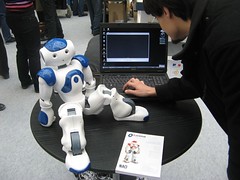
If you think robots are heartless piles of plastic and silicon, you’re correct. But soccer-playing humanoid robot Nao has been evolving by developing “emotions” under a European project and is now being used in the U.S. in sessions to treat autistic children.
Under the recently concluded Feelix Growing project–aimed at designing bots that can detect and respond to human emotional cues–researchers at the University of Hertfordshire’s Adaptive Systems Group and other centers have been trying to get Nao to simulate human emotions.
Researcher Lola Canamero and colleagues have been programming Nao–created by Aldebaran Robotics and used worldwide as a research bot–based on how human and chimpanzee infants interact with others. Working with a budget of some $3.2 million, the researchers have been trying to create robots that can be better companions for people.
In a gushing report, the Daily Mail has hailed Nao as “the first robot capable of developing emotions and forming bonds with humans.”
Robot fans who remember Sony’s robot dog Aibo, discontinued in 2006, will recall that it had a range of synthetic emotions and could “grow” emotionally according to how it interacted with its owner.
It’s no surprise that the researchers have also been experimenting with Aibo, including the cyberpup and Nao in a “robot nursery” designed to incubate emotional behaviors. Nao can so far express excitement, anger, fear, sadness, happiness, and pride, and supposedly has the “emotional skills” of a 1-year-old child.
Using its facial-recognition skills, Nao can become attached to people who help it learn, just like a human infant. When confronted with an unfamiliar situation, or when neglected by its human caregiver, Nao can become agitated. It will remember past experiences it interprets as positive or negative.
Read in Full:Â http://news.cnet.com/8301-17938_105-20013657-1.html?part=rss&subj=news&tag=2547-1_3-0-20
 
Friday, August 13, 2010 – Autism Unexpected by Jean Winegardner
Silver Spring, MD (8/13/10) — I spent last weekend in New York City with 2,400 mostly women bloggers at BlogHer 2010, a conference that brings together online writers from all over the world.
I’ve been to BlogHer before, but this one was special to me because I had the opportunity to speak on a panel titled Blogging Autism: Shattering Myths, Opening Eyes, and Finding Your Tribe.
My co-panelists were a wonderful group of women, each of whom brought something unique to the discussion. Pamela Merritt is an activist who is a co-guardian of her adult autistic brother. Shannon Des Roches Rosa is a powerful and influential voice in the online autism community and mother to a child with autism. Carol Greenburg is an autistic adult as well as the mother of a son with autism.
Each of us shared a myth about autism that we hoped to dispel through our writing. Pamela reminded us that autism is not just a childhood condition. Shannon wants to debunk the idea that autism means misery. Carol brought up the fact that autism and cognitive deficits don’t necessarily go hand in hand but that not all people with autism are genius savants either. I see many myths about autism, but the ones that I mentioned were that autism is not life ending and that there are many different ways to be autistic.
Of course I think the words that we spoke and the comments from the audience were important—very much so. Even more important, however, was the powerful experience of sitting in a supportive room with a group of people who care about people with autism and want the best for them. When you’re in a room like that, you don’t have to explain, you don’t have to justify, you don’t have to be defensive. You just have to be. And you can be because the other people in the room get it, they really, really get it.
Read in Full:Â http://communities.washingtontimes.com/neighborhood/autism-unexpected/2010/aug/13/blogging-autism-and-shattering-myths-blogher-2010/
 
Updated: Sun Aug. 15 2010 4:48:45 PM
Born out of love for a son with autism, one woman’s fight to give her child a better life has led to bettering thousands of others.
Established in 1976 by Joanne Farley, the West Island Citizen Advocacy creates housing for those with mental illness and difficulties for those on the West Island.
The project came about as Farley’s son, Paul, who was diagnosed at an early age with autism, grew up and sought independence.
“She worked very hard from the time he was young to get services started for people with handicaps,” said Farley’s daughter Mary Claire Tanguay, now the program’s director.
Farley also helped meet her son’s needs by starting Special Ed classes, workshops and job programs in the West Island.
Originally opened out of Farley’s home, the West Island Citizen Advocacy project has expanded to serve thousands in its three decades.
“Now we serve 42 people and, in addition to six apartments with three men in each apartment in the community, we have two buildings which provide housing for another 25 people,” said Tanguay.
The two buildings are called Herron House and Farley House – the latter named after her.
Before the program began, those with mental issues were forced to live at home or move downtown.
Now, they thrive in the community, thanks to Farley’s help.
Now 89 and suffering from Alzheimer’s Disease, Farley is no longer active in the program, but has been awarded the Order of Canada and other accolades for her commitment.
Carrying on her mother’s tradition as well as expanding it to others in need, Tanguay looks after anyone who is vulnerable, including a senior advocacy program.
“We serve anybody who has a handicapping condition or people who are disadvantaged and need some defensive rights help,” she explained.
Volunteers are crucial in the success of the project, because they are paired with needy seniors.
“We have about 430 active matches across the West Island,” she said. “These matches help them with practical things, and we help them with emotional support… they might help do the groceries, the banking,” she said.
The pairings help both the needy and the volunteers, said community worker Diane Veuhoff, who said helping with the program has paid off for her.
“I came from an accounting position before, sitting behind a computer where you’re a number. I’m not a number now. I’m making a difference in people’s lives,” she said.
Source:Â http://montreal.ctv.ca/servlet/an/local/CTVNews/20100815/mtl_power_100815/20100815/?hub=MontrealHome
 
First Posted: 08-17-10 11:37 AMÂ Â Â |Â Â Â Updated: 08-17-10 12:57 PM
When Tyler Bell graduated from high school it meant he was one step closer to being an independent — a scary thought considering he’s had to rely on other people his whole life.
Tyler is severely autistic and, when he turns 21, will lose the government support that paid for his special education and therapy needs for the past 17 years. Many adults living with autism lack the proper amount of resources necessary to live a normal life and the fear is that Tyler could end up becoming one of those living alone.
Read in Full/View Video:Â http://www.huffingtonpost.com/2010/08/17/autistic-adults-assistance_n_684133.html