
Calendar

November 2026
M T W T F S S
 1
2345678
9101112131415
16171819202122
23242526272829
30  

Pages

Archives

Recent Posts

Blogroll


Reuters Health


Japanese researchers have found that people who suffer from chronically itchy skin can also have a higher risk of developing anxiety, depression, and stress. In their study, investigators looked at data on more than 2,200 adults, many of whom had skin conditions such as severe acne, eczema, psoriasis, and the severe itching condition known as pruritis. The researchers found that those who had itchy skin were more likely to report psychological symptoms of stress than those whose skin did not itch.  Read full story >


 Houses of Parliament, London

Polly Curtis

guardian.co.uk Thursday 14 January 2010

Conservatives hope to break down barriers facing disabled people who want to be parliametarians, local councillors or civil servants

A £1m fund to help people with disabilities become MPs is being planned under Conservative moves to make parliament more inclusive.

The money would pay for transport and support costs to break down the barriers facing disabled people who want to work as MPs, local councillors or civil servants

It is part of Tory policy to encourage parliament to become more reflective of the country. At the moment one in five people in Great Britain has a disability, but only 5% of MPs are registered disabled. There are currently 126 women in the House of Commons compared to 519 men, and only 15 MPs from ethnic minorities.

Today’s move by the Conservatives would establish an access to public life fund, to be trialled immediately after a Tory victory at the general election. The funds would cover the costs of adapting premises to make them accessible, sign language interpreters, specialised equipment, travel and support workers.

The money – to be spent over four years – would come from efficiency savings made by the government equalities office from their existing £84m annual spending, including from the Equality and Human Rights Commission’s budget. Disability charities would be invited to tender to administer the fund.

Mark Harper, the shadow minister for disabled people, said: “Despite there being over 10 million disabled people in the UK, they are still under-represented in public life. It is important that we break down the barriers which prevent disabled people from standing for public office.

“Given the recent damage done to the standing of parliament and our politics, it is all the more important that we open up our democracy and set up this fund to ensure that disabled people are given a fair chance to enter public life.”

Earlier this week the Speaker published a report of a commission convened to consider the problem, which suggested that there should be quotas set for the number of women, people from ethnic minorities and those with disabilities.

The policy of all-women shortlists that Labour has adopted in some constituencies and David Cameron is considering for this year should be extended to black and minority ethnic groups, it said.

Abigail Lock, head of campaigns at the disability charity Scope, said: “We know many people want to be candidates and that money has been a barrier to that. Campaigning is prohibitively expensive so we welcome this move to break down those barriers.”

Source:   http://www.guardian.co.uk/politics/2010/jan/14/tories-plan-fund-disabled-people


The New York Times has a thought-provoking article on culture and mental illness, arguing that the American view of the disordered mind has been exported around the world and has influenced how other cultures actually experience mental distress.


It’s probably worth saying that none of the examples are solely ‘American’, although clearly it has had a huge influence our ideas about mental illness, despite being reined in on several occasions. Indeed, if mental illness had been truly Americanised, we’d all be living in a Freudian world by now.


Read More …  http://www.mindhacks.com/blog/2010/01/american_madness.html


Development Of New PsycTESTSâ„¢ Tests And Measures Database


Article Date: 12 Jan 2010 – 3:00 PST


APA announced it has begun development of a new research database for tests and measures to be titled PsycTESTSâ„¢.


With an expected debut in the second half of 2010, the new database will differ from currently available resources, serving as a repository for the full text of unpublished test and measures. PsycTESTS is expected to significantly reduce the incidence of researchers and students recreating tests (and thus duplicating work) when they cannot find one that suits their research.


Psychologists have hailed the development of the new database, saying it will advance the field significantly for all professionals regardless of their specialty. Other important features of the database will include information about the availability of reliability and validity data for each test, links to source documents in PsycINFO® and PsycEXTRA®, links to other records related to each test and to other related research, and much more.


“Because it will make analysis of research results among various experiments much easier, over time data sets will become more useful as a direct result. We are very pleased to be introducing such a monumental tool to the field,” states Gary R. VandenBos, PhD, APA Publisher.


PsycTESTS will build on other APA initiatives such as the APA Testing Office’s extensive web site on tests, built by working closely with several standards groups, and APA’s information for the public on testing issues.


One of the inspirations for the database was the Directory of Unpublished Experimental Mental Measures, edited by Bert A. Goldman and David F. Mitchell. The contents of the 9 volumes, currently only available from APA Books in print, will be included among the electronic records.


The tool will also feature historic documents from the Archives of the History of American Psychology at the University of Akron.


Source
The American Psychological Association


http://www.medicalnewstoday.com/articles/175690.php


Neurology, Neurosurgery, and Neuroscience Conferences for 2010


Do you want to attend a neurology, neurosurgery, or neuroscience conference this year? In an effort to provide a consolidated webpage, I’ve compiled what I deem the most exhaustive online listing for 2010. I’ve included as many links as possible to official sources/sites with a rough idea of registration fees; however, should I have left something out, please feel free to comment and I’ll be sure to update the list. Only programs conducted in English are included.


Read More …  http://brainblogger.com/2010/01/10/neurology-neurosurgery-and-neuroscience-conferences-for-2010/?utm_source=feedburner&utm_medium=feed&utm_campaign=Feed%3A+GNIFBrainBlogger+%28Brain+Blogger%29


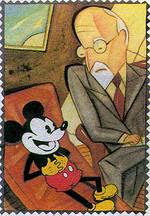
Mickey & Freud

Talking About Mental Health – Mental Health In The Media, UK


Mind’s Open Up project is proud to be supporting the free One in Four conference ‘Talking about mental health – getting it right’ – in London on 1 February. One in Four is a national magazine written by people with mental health difficulties. Open Up is supporting them to deliver the conference as part of their Open Up Initiatives Scheme.


The conference will look at the ways in which mental health and wellbeing is represented in the media and think about how we can all get better at discussing it. It bring together professionals, people who experience mental health difficulties, and people with a foot in both camps, to set a new agenda for how the media, companies and public bodies talk about mental health. Speakers and panellists include: Alastair Campbell, former Director of Communications for Tony Blair, journalist and mental health awareness campaigner, Debra Allcock Tyler CEO, Directory of Social Change, Sue Caro, Senior Diversity Manager, BBC, Jacqui Thornton, former Health Editor The Sun, Shaun Crowe, Regional Co-ordinator, London Mental Health and Employment Partnership and Heather Payne, Media Action Worker at South Warwickshire User Forum.


Places must be booked in advance. For more information and to book a place, go to http://www.oneinfourmag.org. Open Up is part of Time to Change and funded by the Big Lottery Fund.


Source
MIND


http://www.medicalnewstoday.com/articles/175563.php


Voice4u, is a revolutionary AAC (augmentative and alternative communication) application that helps individuals to express their feeling, thought, actions and things they need. It is a perfect solution for learning and communication for autistic individuals and people around them. Also highly recommended for SLPs, teachers, parents, children and adults with developmental disabilities, stroke, or traumatic brain injury.

http://voice4uaac.com/

Related Articles

“iPhone and iPod Touch Apps – Childhood Disability”:

http://www.bellaonline.com/articles/art62136.asp

“Voice4u iPod Touch iPhone Communication App”:

http://www.bellaonline.com/articles/art65220.asp


Lismore Island, Scotland

Autism: it’s time to think differently

Published on 12 Jan 2010

Thousands of adults with autism are missing out on vital services because of a disjointed approach to the condition, claims an MSP who wants to introduce a national autism strategy.

Liberal Democrat MSP Hugh O’Donnell has proposed a member’s bill at Holyrood that would require the Scottish Government to take the lead in co-ordinating services for children and adults with autism ­spectrum disorders (ASDs).

Mr O’Donnell says the Scottish Autism Strategy Bill is part icularly designed to address the problems people with autism encounter at transitional stages of their lives, such as switching schools or moving from education to work.

“Disruption and changes to ­routine can be much more traumatic for young people with autism than for ordinary teenagers – and heaven knows it can be traumatic enough for them,” he says. “So the thrust of this is to try to make sure that these young people, at a crucial stage of their lives, don’t have setbacks that can wipe out any success they may have had in the education system.

“Because autism isn’t a mental health issue or a learning disability issue, in terms of statutory obligation it falls between a number of stools. As a result the service package available is patchy to say the least. A lot of local authorities don’t even know how many people there are in their area with a diagnosis of autism.”

it only takes a few small adjustments and a positive attitude to allow me to contribute in a ­meaningful and healthy way

Elkie Kammer

The National Autistic Society Scotland, which last week launched its own campaign entitled We Exist – A Bill For Autism, A Bill For Scotland, says 94% of people it surveyed ­wanted to see a Scottish autism ­strategy. Figures compiled by the National Audit Office suggest that failure to meet the needs of people with autism is costing the Scottish economy £2.3bn a year through lost job opportunities and the increased burden on public services and families.

With the passing of the Autism Act at Westminster in November 2009 and the establishment of strategic action plans in Wales and Northern Ireland in the past two years, Scotland is now the only part of the UK without a central strategy for people on the autism spectrum.

Support services for autism, which affects an estimated 50,000 people in Scotland, are currently run by health boards and local authorities and can range widely, including speech and language therapy, classroom support, social work and respite care.

The proposed bill would make it a duty for ministers to draw up a ­strategy for autism, incorporating national standards. Mr O’Donnell hopes the bill will be ready to present to Holyrood by the summer, ­following public consultation.

He explains: “At the moment there is a postcode lottery and we need a national approach. Government is supposed to take a lead in these ­matters. It’s not good enough for them to bat it back to health boards and local authorities.

“The idea is to make ministers responsible for a regular annual review of where local authorities are in terms of developing co-ordinated services for people with autism. It would be down to the local authority to have those plans in place and to make sure that those plans met with the national strategic objectives. It’s what’s done in other areas such as heart disease and epilepsy.”

In a survey of people with ASDs ­carried out by the National Autistic Society Scotland last year, one-third of respondents said they had had to go to a tribunal to get the right support.

There are also big information gaps. Last year, four local authorities were unable to provide figures for the first Scottish Government survey of the number of adults in the country diagnosed with autism.

Parents and carers have spoken of the difficulties involved in transition between schools, or moving from one local authority area to another, while young adults often find themselves effectively barred from employment because of a lack of basic support.

Gillian Naysmith, from Dunfermline, has a four-year-old son, Sam, who has been diagnosed with autism and global developmental delay. She says his care has been held up ­repeatedly by poor transition and conflicting advice from professionals.

“On leaving the child development centre, nobody told me that some services would stop and that I would have to physically go to Sam’s paediatrician or GP or health visitor to have him re-referred,” she says.

“We then had to be put back on the ­waiting list, which took around 10 months – a lot of wasted time when they say that early intervention is the best thing possible to help our children.”

She adds that the varied advice offered by experts is confusing for parents. “As a mum, I am looking for advice from the people who should know what the best options are for my son,” she says. “Transitional ­periods should be much smoother. People affected by autism should get all the help they require.”

Problems also often become compounded when children leave school. An NAS report compiled in 2009, ­entitled Don’t Write Me Off, found that only 15% of adults with autism had a full-time job.

James Cusack, who is about to complete a doctorate at Aberdeen University, believes it was only due to the persistence of his parents that he was able to go into higher education. The 24-year-old, who has Asperger’s syndrome, says: “My parents fought desperately to ensure that my local education authority met my needs. The LEA agreed to offer an education and this changed my life. The evidence really does show that without this I would have been in residential care, and on benefits, for the rest of my life.”

One of the strengths of the ­proposed autism bill, says Mr O’Donnell, is that it is a low-cost approach. Much of the data collection, for example, can be achieved using existing surveys. “It would not need a completely new recording methodology,” he says.

“It’s a very simple bill. We don’t anticipate that in terms of cost and workload it will be a huge burden, and that’s important given the circumstances local authorities face.”

Freezing people with autism out of the workforce is not just frustrating and debilitating for the individual concerned; it has a huge cost for ­society through benefits and the cost of deteriorating mental health. The National Audit Office has ­estimated that if just 4% of adults with ­Asperger’s syndrome – a form of autism – were identified and given support, the services would ­effectively pay for themselves through the costs saved to the public purse.

Elkie Kammer, who works with children with developmental disorders in Inverness and has been diagnosed with Asperger’s syndrome, says it sometimes takes just a few small adjustments to allow someone with an ASD to lead a productive life.

The 46-year-old struggles with hypersensitivity to noise, a common manifestation of autism. “At work, electronic noise, background noise or too many people talking at once would cause me so much stress that I had to change jobs very frequently,” she says. “Yet it only takes a few small adjustments and a positive attitude to allow me to contribute in a ­meaningful and healthy way.”

NAS Scotland says the Scottish autism strategy needs to include a duty on the Government to identify the numbers of people with autism. Councils should be required to draw up service plans and train staff. Carol Evans, NAS national director for Scotland, says: “The Government must recognise that people with autism should not be disadvantaged, and support our campaign.”

The case for a national strategy

  • About 50,000 people in Scotland are believed to have an autism spectrum disorder (ASD).
  • About 4900 schoolchildren with ASDs have additional support needs.
  • Half of all appeals to the Additional Support Needs Tribunal are made on behalf of children with autism.
  • Only half of specialist teachers in Scotland have had autism-specific training.
  • Fewer than three-fifths of councils offer specialist units for secondary-age children with ASDs.
  • More than half (53%) of adults with autism say they received no support on leaving school.
  • Only 15% of adults with autism are in full-time employment, yet 79% of those on incapacity benefit said they wanted to work.
  • The National Audit Office believes services for adults with ­Asperger’s syndrome would be cost-neutral if 4% of those adults were offered support, due to savings in medical treatment and benefits from those who could find work. Supporting 6% could save £38m per year UK-wide.
  • 95% of people in the UK surveyed by the National Autistic Society believed councils and health boards should have a legal duty to improve services for people with autism.


The proposal for the bill is available on the Scottish Parliament’s website. Visit www.scottish.parliament.uk/s3/bills/MembersBills/index.htm.

Source:   http://www.heraldscotland.com/news/health/autism-it-s-time-to-think-differently-1.997865


O’Donnell launches Autism Bill

Liberal Democrat MSP for Central Scotland Hugh O’Donnell has launched a Members’ Bill to introduce a national strategy for autism services in Scotland.

Scotland is the only part of the United Kingdom without a national autism strategy, which leaves people with autism in Scotland and their carers facing something of a postcode lottery in terms of service provision. Mr O’Donnell’s Bill will ensure national standards of service and provision and guidance to local providers.

Commenting, Mr O’Donnell said:

“Some of the most successful laws passed by the Scottish Parliament focused on helping marginalised, vulnerable and neglected sections of our society. I want to continue this spirit by launching my Scottish Autism Strategy Bill.

“Scotland is the only part of the UK without a national autism strategy, which means that people with autism across Scotland and their carers face a postcode lottery when it comes to services.

“Although there is some guidance for autism services, none of it is enshrined in law and many areas in the country aren’t providing a basic level of service.

“There are gaps in diagnostic services, crucial if previously undiagnosed Scots are to be identified and the right services provided. There are gaps across the country in many vital support services like child and adolescent mental health services, school support and support into employment.

“Services for families and carers, like respite breaks, also vary wildly.

“My Bill is a first step on the road to equality and better standard of care for all people with autism across Scotland, their families and carers.”

Source:   http://www.scotlibdems.org.uk/news/2010/01/odonnell-launches-autism-bill


January 13, 2010.

A Briton who hacked into NASA and Pentagon computers has won the right to challenge the government’s decision to refuse to block his extradition to the United States, his lawyers said on Wednesday. Skip related content

Gary McKinnon was arrested in 2002 after U.S. prosecutors charged him with illegally accessing computers, including at the U.S. Defence Department and NASA, and causing $700,000 (429,817 pounds) worth of damage.

The U.S. Army’s entire network of more than 2,000 computers in Washington was shut down for 24 hours in what U.S. authorities called “the biggest military hack of all time.”

Lawyers for McKinnon, who suffers from a form of autism known Asperger’s syndrome, say he is not fit to be sent to the United States and that his health would suffer.

But Home Secretary Alan Johnson said in November that the information he had been provided with did not demonstrate that sending McKinnon to the U.S. would breach his human rights, therefore he could not block the extradition.

McKinnon’s lawyer Karen Todner said she was delighted with the High Court decision but said the pressure of the proceedings had left her client in a “very poor mental state.”

“I would urge Mr Johnson to review his decision and I appeal to (U.S. President Barack) Obama to withdraw the application for extradition,” she said in a statement.

The hearing was expected in April or May, she said, and McKinnon would remain in Britain pending the review.

The Home Office noted the decision and said in a statement that it would not comment further, pending the review’s outcome.

A judicial review examines whether a public body came to its decision lawfully — so Johnson could again allow McKinnon’s extradition to go ahead, as long as he followed the right procedures in coming to his decision.

McKinnon has told Reuters he was just a computer nerd who wanted to find out whether aliens really existed. He became obsessed with trawling through large military data networks for any proof that they might be out there.

If convicted by a U.S. court, McKinnon could face up to 70 years in prison.

(Reporting by Kylie MacLellan; Editing by Jon Boyle)

http://uk.news.yahoo.com/22/20100113/tuk-uk-britain-hacker-fa6b408.html

A plea from Gary McKinnon’s mum: text the Government to show your support

By Christopher Hope Last updated: January 12th, 2010

Here is a heartfelt plea from Janis Sharp, the desperately worried mother of Gary McKinnon, the Briton who is wanted in America on computer hacking charges and faces decades in jail if found guilty.

She says: “Please help my son Gary McKinnon by Texting GARY to 65000 to show Government the level of support there is for Gary in the U.K  before court decision or extradition can take place. For more info see:  http://www.londontv.net/press-release.html#freegary

The ambition of the texting campaign is “two-fold”.  The campaign’s website says: “First to give voters an opportunity to directly manifest their frustration at a lack of protection for vulnerable UK citizens such as Gary, and second to encourage the main political parties to reform our imbalanced extradition arrangements as part of their manifesto pledges.

“Any British Citizen can be extradited to America without any evidence being presented on a mere suspicion. THIS HAS TO END.”

Any day now Mr McKinnon, who has a form of Autism, will learn whether the High Court will grant a judicial review of the decision by Alan Johnson, the home secretary, to ignore fresh medical evidence about the effect of being extradited on him.

Ms Sharp has thrown her every ounce of energy into trying to keep her son in Britain, where he is happy to answer charges (he is accused of hacking into Pentagon and Nasa networks from his bedroom in north London). She has had extraordinary success: on the first day of the texting campaign nearly 4,000 texts were sent in support of Mr McKinnon.

Yet the Government has been deaf to her pleading and has been content to fall into line with the wishes of the US Justice department, in what many see as a supine show of deference towards Uncle Sam, by extraditing Mr McKinnon using an unfair treaty which was designed to target terrorists.

Proposals from Dominic Grieve, the shadow Justice secretary, to introduce a clause into the treaty to prosecute offenders in the UK if the majority of the crime was committed here are a palpably sensible solution to an unfair piece of law-making which discriminates heavily against Britons.

Source:   http://blogs.telegraph.co.uk/news/christopherhope/100022087/a-plea-from-gary-mckinnons-mum-text-the-government-to-show-your-support/

Judge says extraditing Gary McKinnon may be unlawful

Asperger’s sufferer faces lengthy prison sentence in the US for breaching US military and Nasa computers

Afua Hirsch

The Guardian, Thursday 14 January 2010

The home secretary may have acted unlawfully by pursuing the extradition of the computer hacker Gary McKinnon, a high court judge said yesterday.

Extraditing McKinnon, an Asperger’s sufferer who is facing a lengthy prison sentence in the US for breaching US military and Nasa computers, raises “stark and simple issues”, Mr Justice Mitting said.

In a letter, the judge described medical evidence that McKinnon would be at high risk of suicide in an American jail as “as yet unchallenged and unqualified”.

That evidence may require the home secretary “to refuse to surrender [McKinnon] to the government of the USA” Mitting said, in a letter yesterday. “It is arguable that the [home secretary’s] decision was unlawful”, the letter added.

The decision is seen as a dramatic change from the approach of the high court in previous hearings on McKinnon.

His mother, Janis Sharp, said: “I can’t believe it – some common sense at last. This judge has made such an honourable and decent decision. Gary’s health has badly declined it’s been traumatic to see. I hope this brings him comfort that the right decision will be made, even if it requires the courts to impose it rather than our government to reach it.”

Read in Full:  http://www.guardian.co.uk/world/2010/jan/13/gary-mckinnon-hacking-extradition?CMP=AFCYAH


Previous Updates

 http://aspie-editorial.blog-city.com/gary_mckinnon_updates_new_hope_on_extradition.htm


Monday, Jan. 11, 2010

By John Trumbo, Herald staff writer

RICHLAND — Being autistic doesn’t mean Bill Peters avoids hanging out with friends.

The 27-year-old Richland man loves being around people and enjoying the social interaction even though he’s known since childhood that he is “different.”

That’s why Peters, who has a form of autism known as Asperger’s, and a few friends have formed a new social group for high-functioning autistic people.

“I think it’s a wonderful idea,” said Karen Hayes, executive director of The Neurological Resource Center in Richland.

Hayes said the need is real because high-functioning autistic people feel like others are judging them.

People who aren’t familiar with autism may not understand the odd behaviors, and become judgmental and lose patience with autistic people — even those who are high functioning like Peters, said his mother, Norma Peters.

Peters is talkative, outgoing, enjoys learning and teaching languages. But Peters also tends to not observe social cues such knowing when to let someone else talk or maintaining an appropriate personal space.

And Peters also can become fixed on repetitive behaviors, such as watching the same movie endlessly.

Then there are the autistic moments when he gets “stuck” or has an emotional meltdown.

But what would put off some people is no offense to high-functioning autistic adults who are more accepting, his mother said.

Peters and some of his autistic friends are core members of the new social group they call Three Rivers Autistic Outreach.

Peters envisions the outreach effort as a way to help autistic people learn to accept themselves and others like them by having monthly gatherings to talk, watch movies and play games.

Peters lives independently with a roommate. He attended Richland schools, endured incorrect diagnoses of being developmentally disabled and having attention deficit disorder, and survived schoolyard bullying.

Young adults who are autistic have a longing to be accepted by others and themselves, said Ellen, a 39-year-old Kennewick woman who would not provide her full name because of the social stigma she fears she will again experience by publicly disclosing her disability.

“It’s hard to say, but I used to think that I was a freak,” said Julie Meier, a married mother of three from Richland.

“I had trouble finding acceptance and understanding before I met Ellen. I didn’t know of other high-functioning autistic people,” Meier said.

Ellen, whose autistic diagnosis is pervasive atypical development disorder, is a high school and college graduate and trained as a paralegal.

Meier learned of her Asperger’s condition a few years ago when her husband suggested she be tested for autism.

But when Meier and Ellen became acquainted after meeting at an autism picnic, the social connection clicked.

“It’s a very isolating condition,” said Ellen. But once people with autism who are high-functioning link up socially, their lives have a new dimension.

“We have a unique understanding, we laugh together. We don’t notice the twitches. We can just be ourselves,” she said.

“Without having people look at you funny,” Peters added.

Another reason Peters formed the peer group is that plenty of support can be found for young autistic children, but there isn’t much for autistic young adults, particularly high-functioning people.

“The high end (of autism) gets ignored. You can’t find others so easily,” Peters said.

Having to live as a high-functioning autistic person can be challenging, said Ellen, particularly when it comes to getting and keeping a job.

“Everything is set up for people who are flexible, who can do handle change,” Ellen said.

“We have things we are good at, and repetitive behaving is good for us,” Peters said.

Some employers don’t understand that people with high-functioning autism don’t necessarily see the whole picture and can’t see change coming, Meier explained.

But high-functioning autistic workers are motivated to be on time, reliable and are sticklers for the rules, said Ellen, who says she completed the paralegal program at Columbia Basin College with a 3.4 grade-point average.

The next gathering of the Three Rivers Autism Outreach will be 3 p.m. Jan. 17 at The ARC of Tri-Cities, at 761 Williams Blvd., in Richland. A movie night is planned for Feb. 6, but a location isn’t decided, Peters said.

For more information about the autism social group, call Peters at 946-8174.

Source:  http://www.tri-cityherald.com/kennewick_pasco_richland/story/857879.html


Saturday, 9 January 2010

Coloured lights could be used to find treatments for brain disorders such as epilepsy, a study has suggested.

A Massachusetts Institute of Technology team discovered a way to shut down brain activity using flashes of yellow and blue lasers.

They hope to adjust this to switch off neurons that generate an electrical impulse abnormally, causing seizures.

This could help experts understand how the brain works and, ultimately, offer treatment targets, Nature reports.

The work relies on two genes found in natural organisms like algae that need light to make energy.

Illuminating

These genes, known as Arch and Mac, contain the genetic code for light-activated proteins.

The MIT team engineered brain neurons to express Arch and Mac.

By doing this, they were able to control the brain cells of mice and monkeys using light.

Light activates proteins which, in turn, lowers the voltage in the neurons and prevents them from generating an electrical signal, known as firing.

Arch responds to blue light, Mac to yellow, and both recover afterwards.

Now the researchers plan to closely examine the neural circuits of the brain in the lab to find targets that, when shut down, could treat epilepsy as well as other conditions including Parkinson’s disease and chronic pain.

Ed Boyden, who led the research, said: “Silencing different sets of neurons with different colours of light allows us to understand how they work together to implement brain functions.

“These tools will help us understand how to control neural circuits, leading to new understandings and treatments for brain disorders.”

Although the work has involved animals, it should shed light on what is happening in humans, he said.

Professor Gero Miesenbock of Oxford University has been using the same technology in his research, which has included studying memory formation in fruit flies.

He has said the technology is “beginning to yield previously unattainable insight” into the organisation and regulation of the neural circuits of the brain, and the link between patterns of cellular activity and behaviour.

Source:   http://news.bbc.co.uk/1/hi/health/8441983.stm


By Katie Boer KPIC News and KPIC.com staff

WINSTON, Ore. — About once a month, elephants Tiki, Alice and George get a special visit from 10-year-old Wylie Malek.

“Wylie was diagnosed as autistic at the age of 3,” said his father, Kris Malek. “When he started school about kindergarten they kind of moved it up to a high functioning autism.”

For some children with autism, animal interaction improves their social skills and decreases anxiety. That can mean dogs, cats, rabbits — or elephants? At Wildlife Safari, Wylie has bonded with animals 312 times his size.

“This is the one animal,” Kris Malek said. “I mean he’s been interested in elephants basically since he climbed out of the womb.”

Wylie found elephants — and people interested in elephants — at Wildlife Safari in Winston, Ore.

“People kind of tend to be really complicated,” said Katie Alayan, senior elephant keeper at Wildlife Safari. “Animals are a lot simpler. They’re a lot easier to understand, they’re a lot easier to relate to in some ways, especially for a child who might not have the same social abilities.”

The interaction has given Wylie — now a junior elephant keeper — a goal.

“When I grow up, I want to work here,” he said.

In some ways, he already does.

“He’ll actually help us when we’re doing baths and things like that,” Alayan said, “Putting their ears out, picking their feet up, he helps us scrub on them.”

Volunteering at the Safari gives Wylie a sense of responsibility.

“He calls it work,” his father said. “He tells his sisters all the time he’s got to go to work — or go to his job is usually how he phrases it.”

Wylie has told the the elephant trainers stories about dinosaurs and dragons, but he can tell you facts about the elephants.

“Wylie can say all the weird things in the world he wants to. The elephants don’t care,” his dad joked. “They think that’s probably just normal. Heck he could have a normal conversation with an elephant all day long I guess.”

The staff at Wildlife Safari said the once-timid 10 year old has really come out of his shell.

“It’s so rewarding for us as people who care for these animals everyday, day in and day out,” Alayan said. “We love to interact with someone who clearly gets so much out of them.”

“Being around wylie and watching him learn things that most kids don’t get to, there’s no words to describe it,” said Timothy Hamilton, another elephant keeper. “Just watching him smile makes me ecstatic.”

Source:   http://www.kpic.com/news/local/81183427.html

Related Articles

“Thailand: Elephant Therapy to Treat Depression/Aid Autistic Children”:

http://aspie-editorial.blog-city.com/thailand__elephant_therapy_to_treat_depressionaid_autistic.htm


Musings on Intelligence and Creativity in Society

A prodigious savant joins the wider world


« Older Entries Newer Entries »